
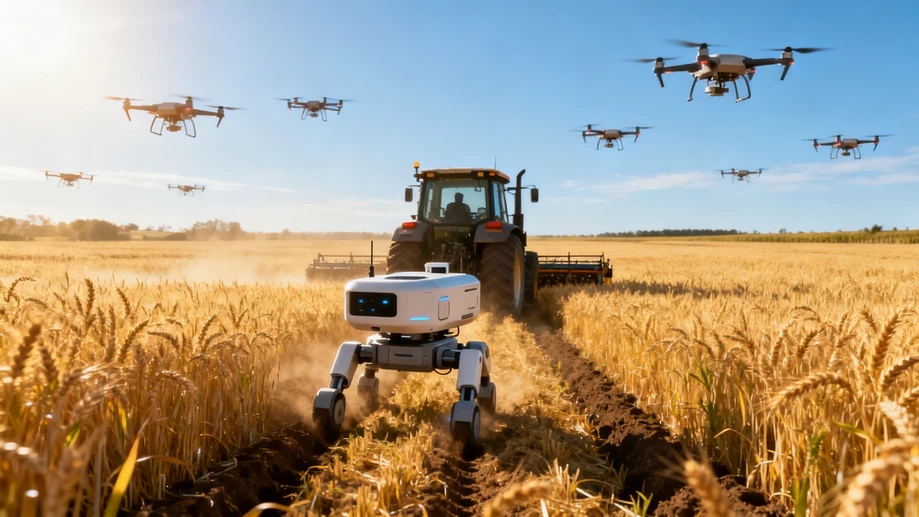
Agricultural Robots Are Quietly Revolutionizing How We Grow Our Food
Autonomous machines and AI-driven systems transform farming with unprecedented precision while tackling labor shortages
Agriculture has entered a technological renaissance where once-futuristic concepts now operate in fields worldwide. Machines equipped with advanced sensors work tirelessly through day and night cycles, performing tasks that previously required armies of human workers. This robotic infiltration addresses the industry's acute labor crisis while boosting productivity metrics beyond traditional farming capabilities. Farmers increasingly report reliance on these mechanical helpers as seasonal workforce availability declines across global agricultural regions. The transition hasn't been sudden but rather a steady evolution where autonomous systems gradually expand their operational scope from soil preparation to harvest phases.
Among the most transformative applications are self-driving tractors that map fields centimeter by centimeter during planting season. These machines apply seeds with surgical accuracy based on real-time soil analysis, optimizing placement depth and spacing according to moisture and nutrient levels detected beneath the surface. Simultaneously, drone fleets equipped with multispectral cameras patrol from above, identifying crop stress indicators invisible to the human eye weeks before symptoms manifest. The collected data enables predictive interventions, such as localized irrigation or micronutrient adjustments. Interestingly, robotic weeding units utilize computer vision to distinguish between crops and invasive plants with uncanny accuracy. Did you know? Some models eliminate weeds using precisely targeted micro-bursts of compressed air rather than herbicides.
The economic implications continue reshaping farming economics as early adopters report remarkable efficiency gains. A strawberry farm employing robotic harvesters documented a 30% yield increase simply because machines pick continuously through night hours when fruits reach peak ripeness. Similarly, vineyards using autonomous pruners demonstrate healthier vines as AI algorithms determine optimal cutting points based on growth patterns and disease resistance models. Reduced physical strain on farmworkers accompanies these productivity benefits, with repetitive motion injuries declining noticeably where robotic systems handle labor-intensive tasks. Still, adoption rates diverge significantly across regions due to substantial upfront investments required for automation infrastructure.
Ongoing innovations focus increasingly on versatility as agricultural robotics advances beyond single-task machines. Modular platforms now enter testing phases where one base unit can be reconfigured for multiple functions—planting attachments swapped for weeding modules or harvesting arms within hours. This adaptability proves crucial for smaller farms needing multipurpose solutions. Advancements in machine learning algorithms further enhance robotic perception, enabling systems to navigate unpredictable terrain while identifying subtle variations in plant health. The falling cost of sensor technology accelerates this evolution, making sophisticated automation accessible to mid-sized operations previously excluded by economic barriers. Training datasets compiled from millions of field images teach robots to recognize dozens of crop varieties under diverse lighting and weather conditions.
Technical challenges nevertheless persist in robotics development, particularly regarding delicate handling requirements for fragile produce like tomatoes or raspberries. Engineers experiment with biomimetic designs featuring compliant grippers that replicate human touch sensitivity using pressure-sensitive polymers and force feedback systems. Another frontier involves swarm technology where dozens of small collaborative robots communicate through mesh networks to coordinate complex tasks across large fields. Such approaches could make robotic solutions viable for crops like asparagus requiring precise selective harvesting. The pursuit focuses not on replacing humans entirely but creating symbiotic workflows where farmers oversee robotic fleets while focusing on strategic management decisions.
Potential impacts ripple beyond farm gates as agricultural robotics influences environmental outcomes through precision resource management. Water consumption drops significantly when automated systems irrigate only where needed, responding to soil moisture sensors rather than predetermined schedules. Fertilizer application rates decline by half when machines deliver nutrients directly to root zones based on individual plant requirements. The dawn of 24-hour autonomous farming cycles promises not just enhanced productivity but fundamentally reimagined agricultural methodologies. This technological transformation positions itself as a critical response to rising global food demands, reshaping our relationship with cultivation through circuits and algorithms rather than solely sweat and tradition.