
Did You Know Discarded Crisp Packets Are Reshaping Hidden Coastal Ecosystems Most People Never Notice
This cross-continental field observation from global coastal conservation groups reveals a little-discussed connection between casual littering of everyday snack packaging and the gradual collapse of quiet sand dune habitats that support thousands of marine and terrestrial species.
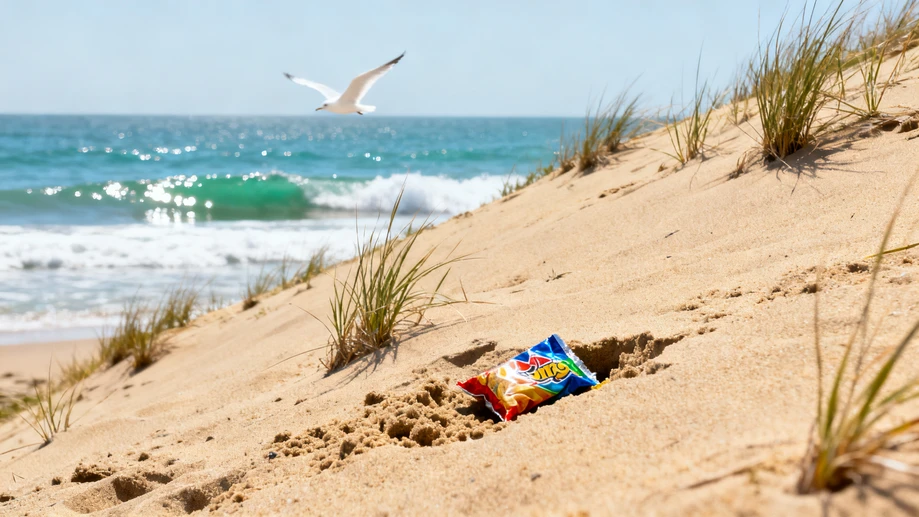
For hundreds of millions of annual coastal visitors, a day at the beach usually includes sunbathing, swimming, eating a bag of crispy snacks while watching seagulls fly over the waves, and picking up obvious plastic bottles or drinking straws before heading home. Few people pay attention to the narrow strips of sand dunes located dozens of meters away from the tourist swimming zone, and even fewer notice the thin, shiny snack packaging bags blown by sea wind into deep gaps in those dunes. Over the past five years, volunteer teams from 12 coastal countries including the United Kingdom, Australia, Japan and China have carried out full-coverage litter surveys on 79 untouched sand dune plots that have no direct footprints of ordinary tourists. The final statistics show that discarded snack packaging such as crisp bags and candy wrappers account for 42 percent of the total weight of all plastic waste in these natural dune areas, far exceeding the proportion of plastic bottles, fishing lines and other wastes that have long been the focus of public environmental campaigns. Most of these thin plastic packages are left by visitors dozens of kilometers away, carried by continuous sea breeze across roads and beaches, and finally buried in sand dunes where no one will clear them for decades.
The harm caused by these light, easy-to-travel plastic wastes is not as immediate as large pieces of plastic that entangle seabirds or marine turtles, but it slowly rewrites the basic physical properties of sand dunes in a near-invisible way. Natural healthy sand dunes rely on dense root systems of native dune grasses to fix sand grains, and gaps between loose sand can store rainwater and dew quickly, maintaining a stable humid micro-layer under the surface that supports the survival of hundreds of small creatures. The thin plastic film of crisp bags will be gradually covered by blown sand after staying on the dune surface for a few months, forming a hidden water-blocking layer 2 or 3 centimeters under the surface. Rainwater that used to seep into deep sand within a few minutes now flows away along the plastic layer to the dry dune edges, leading to a continuous drop of water content in the root area of dune grasses. In the long run, the originally tough and drought-resistant dune grasses will wilt and die in large areas because they cannot get enough water, and the dunes will gradually turn into loose moving sand piles that cannot support any special native species.
Conservation teams have recorded a clear chain of ecological collapse linked to snack plastic waste at a monitoring site on the north coast of Devon, UK, since 2020. The number of dune beetles, a small native insect that lays eggs specifically in the 2-centimeter-deep humid sand layer, dropped by 68 percent in three consecutive years, and local researchers initially suspected that the population decline was caused by invasive alien ant species. After two years of tracking and comparison, they finally confirmed that more than 70 percent of the egg-laying areas suitable for dune beetles at the site had been covered by hidden fragmented crisp bag films, and the humid sand layer required for larval survival no longer existed. As the number of dune beetles, the main summer food for local wading birds, dropped sharply, the number of breeding pairs of ringed plovers that build nests on the local dunes dropped by 52 percent in the same period, breaking a stable population record that had been maintained for more than 18 years.
The good news is that solutions to this hidden ecological crisis do not require super high cost technical support or difficult to implement industry-wide bans. Many coastal scenic areas in the Netherlands and the UK have set up dedicated clear recycling bins for flexible plastic snack packaging at beach entrances since 2022, and more than 60 percent of visitors are willing to put their empty crisp bags into these special bins instead of throwing them into ordinary trash cans that are easy to leak by wind. Several major snack manufacturers in Europe and East Asia have also launched trial production of fully plant-based packaging films for crispy snacks, which can maintain the same sealing and freshness protection performance in normal use, and can be completely decomposed into non-toxic organic matter within 18 months after being buried in sand. At the three pilot dune sites where new biodegradable packaging has been fully used and targeted waste cleaning has been carried out, the water content of the sand layer at a depth of 2 centimeters has increased by 17 percent within six months, and the dune beetle population that had disappeared for three years has been observed to return to lay eggs again.
This widespread and long ignored environmental reminder shows that most of the ongoing global ecological changes are not caused by shocking large-scale industrial pollution accidents, but are pushed forward by countless tiny casual habits in daily life. A crisp bag you carelessly discard on the parking lot 3 kilometers away from the beach can be carried by sea breeze to the deepest part of a dune that no one has ever stepped on, and gradually change the living environment of hundreds of small creatures that are connected to the entire coastal food chain. More than 12000 civilian conservation volunteers around the world have joined the dune plastic monitoring program so far, marking and counting hidden plastic fragments in sand dunes with ordinary smart phones, and the data they have collected has helped researchers draw a global distribution map of dune plastic invasion, providing clear guidance for subsequent targeted protection actions.