
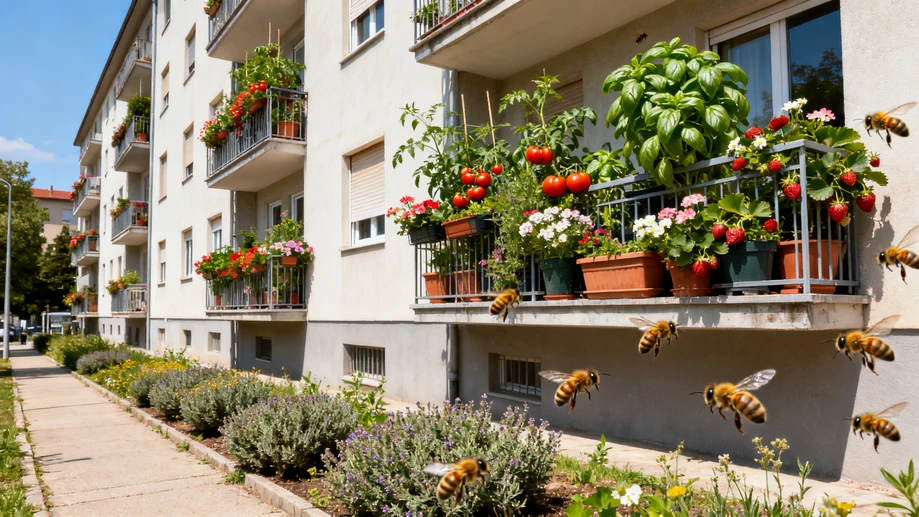
Have you ever thought your balcony tomato plants are part of a global unreported research project
Millions of casual urban home gardeners have unwittingly created the largest real-time data set of wild pollinator activity ever recorded, no official research budget required
The 2024 Food and Agriculture Organization report on global pollinator population trends released last month caught almost every veteran entomologist off guard, as its core data set is 17 times larger than the sum of all formal monitoring projects launched over the past 12 years. No government allocated extra research funding to expand the survey range, no new high-tech tracking sensors were deployed across global cities, and the breakthrough came completely from the casual daily posts of millions of ordinary urban residents around the world. After the global home gardening boom that started during pandemic lockdowns, people who planted tomatoes, basil, strawberries and other small edible crops on their balconies and windowsills began sharing photos of their growing progress on local gardening groups and public social platforms, often with accidental shots of bees, butterflies and other small insects resting on flower buds. Automated data crawlers developed by independent environmental research institutions collected these geotagged photos, filtered out duplicates, verified species with public open source insect identification tools, and built a data network that covers 78 percent of residential areas across 142 countries, filling almost all the urban data gaps that formal research teams could not cover with limited manpower.
This massive unplanned data collection effort overturned a long-standing consensus in entomology almost overnight. For decades, academic circles have assumed that the urban heat island effect, the large area of hard pavement and the lack of native flowering plants would reduce the number of wild pollinators in urban areas by at least 40 percent compared with surrounding suburban and rural areas. The new civilian collected data proves that if the proportion of flowering native plants on residential balconies in a single city block exceeds 30 percent, the number of wild pollinators in that block can be 22 percent higher than that in adjacent large-scale industrial agricultural areas that use large amounts of pesticides. Several species of solitary bees that were listed as locally extinct in official regional records more than 10 years ago have been spotted dozens of times in recent months, nesting in the loose soil of balcony potted mint and basil, in residential neighborhoods that entomologists have not conducted field surveys in for years.
The ripple effect of these unexpected findings has already penetrated into the daily operation of many cities, far faster than any policy promotion process could achieve. Municipal landscaping departments in more than 200 medium and large cities around the world have stopped prioritizing double-petal ornamental flowers that carry almost no accessible nectar for pollinators when renovating roadside green belts, and instead selected native clover, wild berry shrubs and flowering herbs that provide sufficient food for wild insects as the main greening species. Multiple global coffee chain brands have launched a small gift program that gives away packets of native pollinator-friendly plant seeds to customers who bring their own reusable cups, with no government mandate or public subsidy behind the move, just because store managers noticed more and more customers talking about their balcony gardening experiences online.
The global non-profit platform that aggregated all these public photo data has now launched a completely free and accessible entry system that does not require any professional background or relevant academic certification. You do not need to master complex insect classification knowledge, you do not need to buy expensive professional photographic equipment, and even a blurry photo you take with your mobile phone that clearly shows the insect and the flower it lands on, with your location information marked, can be incorporated into the global public ecology database. A middle school student in Vancouver recently found a rare hover fly species that had not been recorded in North America for 27 years on her balcony potted dill, and her casual observation was added to the official IUCN species distribution map, making her one of the youngest contributors to the global pollinator monitoring project.
The most fascinating part of this whole incident is that it was never planned or designed in advance at all. No research institution issued a formal call for participation, no public welfare organization launched a large-scale publicity campaign, and millions of people joined in just to enjoy the fun of growing their own fresh vegetables and flowers at home, with no awareness that their trivial daily hobby was generating core data that could reshape global ecological governance strategies. For decades, the public has been told that large-scale environmental restoration projects require massive investment, top-level policy design and professional elite participation, but this real-world case clearly proves that the most powerful ecological force often hides in the small, scattered daily choices of ordinary people, and no grand, distant plan can match the vitality of a large group of people spontaneously doing small, meaningful things at their own homes.