
3 Cosmic Mysteries Unlocked by Stargazers This Year
From Diamond Worlds to Ghostly Galaxies, the Universe Just Got Stranger
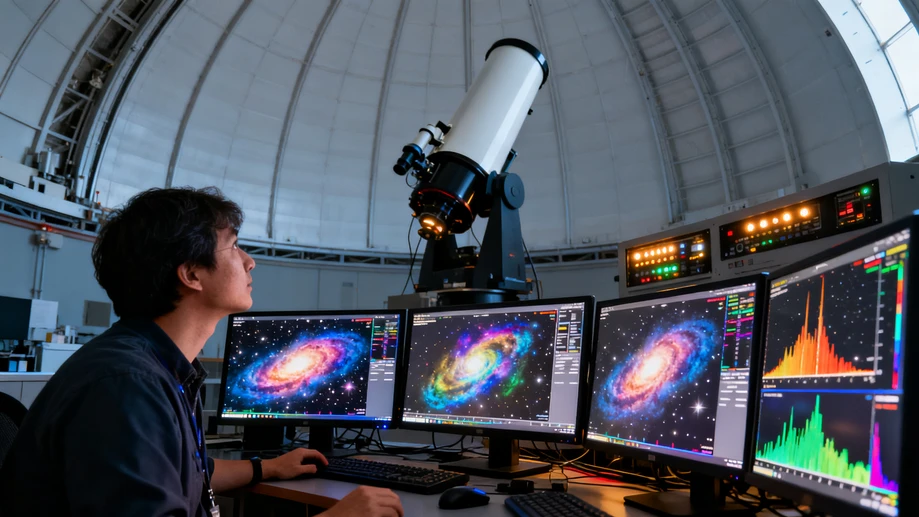
Forget science fiction; reality is proving far more bizarre. This year, astronomers peering into the vast cosmic ocean have reeled in catches that challenge our textbooks and ignite our imaginations. Using cutting-edge telescopes both on Earth and in space, they've uncovered phenomena that sound like they belong in a fantasy novel, yet are undeniably real. These aren't distant possibilities; they're happening right now, billions of light-years away, reshaping our fundamental understanding of how stars live, die, and what strange objects they leave behind. The universe, it seems, is an even more inventive place than we dared dream.
One jaw-dropping discovery involves the ultimate cosmic bling. Imagine a planet not made of rock or gas, but primarily of crystallized carbon – a diamond. Scientists, analyzing the light from a peculiar, ultra-dense stellar remnant called a white dwarf, realized its composition was unlike anything seen before. The intense pressure and fading heat within this dying star's core are thought to have forged a colossal diamond crystal, potentially hundreds of kilometers across. This isn't just a shiny bauble; it's the exposed, crystallized heart of a star that shed its outer layers. While we won't be mining it any time soon (it's incredibly distant and hostile), it proves that nature's alchemy can create treasures far beyond Earthly gems.
Then there's the case of the galaxy that shouldn't exist, or at least, shouldn't look the way it does. Nicknamed the "Ghost Galaxy" (formally known as NGC 1052-DF2), this large, diffuse collection of stars presented astronomers with a profound puzzle: it seemed to have almost no dark matter. Dark matter, that invisible, mysterious substance thought to make up most of the universe's mass and act as the gravitational glue holding galaxies together, was conspicuously absent here. Subsequent observations confirmed this anomaly. How did this galaxy form? How does it hold itself together without the cosmic scaffolding everything else seems to need? Its very existence throws a wrench into our best models of galaxy formation, forcing scientists back to the drawing board to explain how such an ethereal island of stars could come to be.
Closer to home, in the search for life beyond Earth, a potentially habitable world orbiting a cool red dwarf star (K2-18b) made headlines again, but with a surprising twist. While initial excitement focused on the detection of water vapor in its atmosphere, a deeper analysis using the powerful James Webb Space Telescope revealed tantalizing hints of something else: dimethyl sulfide (DMS). On Earth, DMS is produced almost exclusively by biological processes, primarily by phytoplankton in our oceans. Finding it in the atmosphere of another world is a potential biosignature – a sign of life. Crucially, Webb also detected methane and CO2, adding to the picture of a hydrogen-rich atmosphere over a possible water ocean. While the DMS detection is tentative and requires much more confirmation, it marks a significant milestone: the first time a potential biosignature has been hinted at on a habitable-zone exoplanet. The search for life now has its most intriguing target yet.
These discoveries, the diamond star, the ghostly galaxy, and the world whispering of biology, are more than just cosmic curiosities. They are fundamental challenges. They force us to confront the gaps in our knowledge, pushing the boundaries of physics, chemistry, and our understanding of life's potential. They remind us that the universe is under no obligation to make sense to us on first glance. Each answered question reveals ten more, proving that the greatest story ever told – the story of the cosmos – is still being written, chapter by astonishing chapter, right above our heads. Our telescopes are the pens, and the ink is pure starlight, revealing a reality stranger and more wonderful than fiction could ever devise.