
5 Cosmic Secrets That Will Make You Rethink Your Place in the Universe
From dancing galaxies to diamond planets, the cosmos just got a whole lot weirder than your wildest dreams.
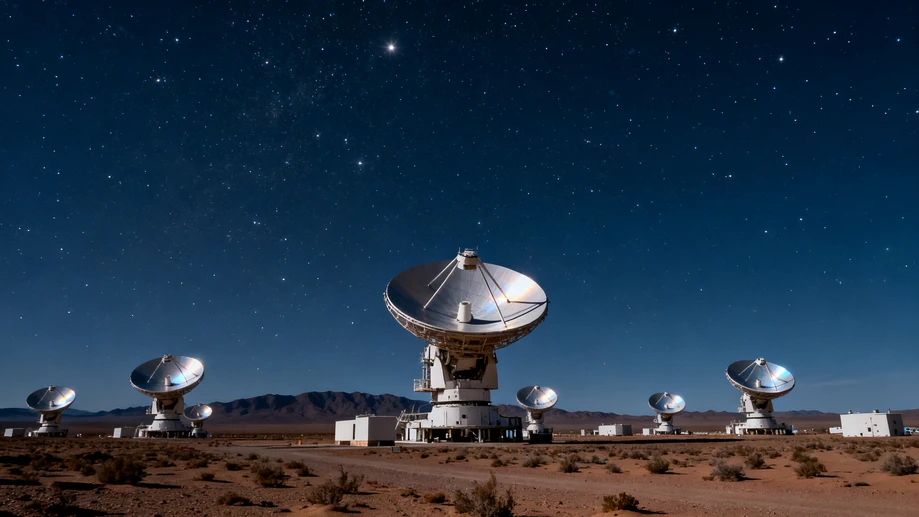
Astronomers have cracked open a treasure chest of celestial wonders that rewrite our cosmic storybooks. Imagine planets where it rains rubies, galaxies performing gravitational tangos, and black holes singing in basso profundo. These aren't sci-fi fantasies but peer-reviewed revelations from telescopes scanning the heavens. The latest data from the James Webb Space Telescope reveals infant galaxies forming just 300 million years after the Big Bang – cosmic toddlers in diapers of stardust. Meanwhile, radio dishes capture the eerie hum of colliding supermassive black holes, a soundtrack to the universe's violent ballet. These discoveries prove reality often outshines imagination when it comes to cosmic drama.
Consider the curious case of WASP-121b, a Jupiter-sized planet where clouds literally rain liquid sapphires. Hubble Telescope data shows this exotic world's atmosphere reaches scorching 2,500°C, vaporizing metals that condense into glittering mineral rain. Then there's the diamond planet 55 Cancri e, twice Earth's size with a carbon crust compressed into crystalline perfection. These bizarre worlds challenge our definition of "habitable" – proving that life-friendly conditions might exist in environments we'd consider hellish. Planetary scientists now hunt for chemical signatures in these alien atmospheres, searching for molecules that could hint at biological processes beyond Earth.
The cosmic cannibalism happening in our galactic backyard will make you clutch your telescope. Astronomers recently witnessed a Milky Way neighbor – the Large Magellanic Cloud – devouring its smaller companion galaxy in a slow-motion feast lasting billions of years. Using the Gaia space observatory, researchers mapped stellar streams like cosmic breadcrumbs marking this celestial consumption. Even our own galaxy isn't innocent; the Milky Way's gravity is currently shredding the Sagittarius Dwarf Spheroidal galaxy into a sparkling river of stars. These galactic meals fuel star nurseries where new suns ignite, proving destruction and creation are cosmic dance partners.
Black holes continue to astound with their gravitational gymnastics. The Event Horizon Telescope collaboration captured unprecedented footage of plasma jets erupting from M87's supermassive black hole – energy beams stretching 5,000 light-years into space. More curiously, astronomers detected a "hiccuping" black hole in galaxy GSN 069, burping material every nine hours like a cosmic metronome. Then there's the discovery of rogue black holes drifting through interstellar space, having been kicked from their galactic homes during cosmic collisions. These invisible wanderers reveal themselves by distorting starlight like funhouse mirrors, creating eerie gravitational mirages.
Closer to home, our solar system keeps revealing hidden gems. The Juno spacecraft's recent Jupiter flyby unveiled electric-blue lightning storms raging 15 miles wide in the gas giant's clouds. Meanwhile, Saturn's moon Enceladus sprays geysers containing organic compounds through its icy crust, while Europa's subsurface ocean holds twice Earth's seawater. These discoveries transform our search for extraterrestrial life from sci-fi speculation to concrete scientific pursuit. NASA's upcoming Europa Clipper mission will taste these alien plumes, hunting for molecular building blocks in what might be the solar system's most promising extraterrestrial aquarium.