
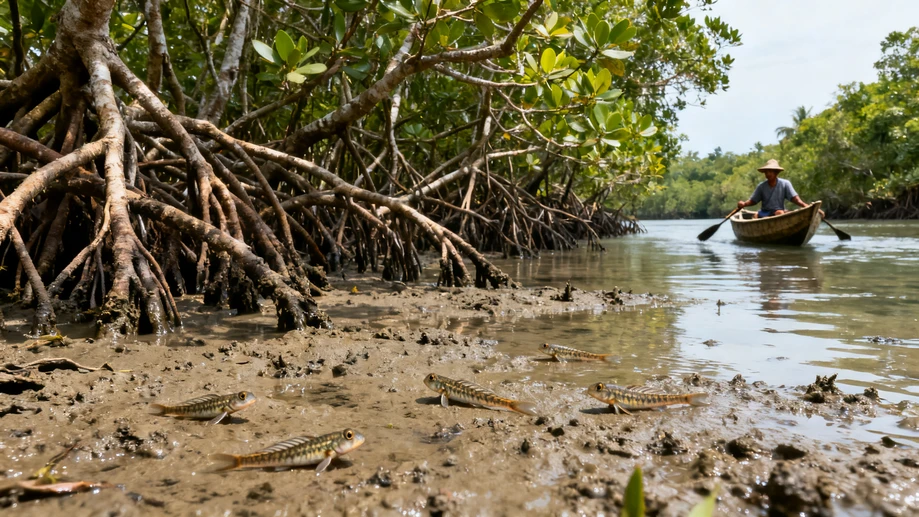
Have You Noticed The Overlooked Coastal Ecosystem That Fights Climate Change Three Different Ways At Once?
This field report breaks down the little-known daily impacts of mangrove forests, from supporting local fishing communities to slowing ocean erosion, using real data collected by grassroots conservation teams across 12 tropical countries over the past three years.
Most travelers who have visited tropical beach destinations in Southeast Asia, Central America or northern Australia have walked past stretches of twisted, tangled trees growing in soft, muddy intertidal zones, and paid little more attention to them than a quick snapshot before heading to the white sand shore. Very few people stop to consider that these unassuming plants, which are often dismissed as unappealing swamp vegetation, are some of the most powerful natural tools the planet has to slow the worst effects of global warming. Data from the latest United Nations Environment Program community survey shows that one hectare of fully mature mangrove forest can store up to 25 tons of carbon in its roots, branches and surrounding sediment every year, which is more than four times the carbon sequestration rate of an equivalent area of old-growth tropical rainforest. Even more surprising, nearly 70% of that stored carbon stays locked in the thick, waterlogged mud under the trees for centuries, with no chance of being released back into the atmosphere even if above-ground branches are damaged by storms or wildfires.
The ecosystem provides a second critical climate protection function that most local coastal residents only truly learn to appreciate the first time a major tropical storm hits their town. A 2021 post-typhoon assessment of 47 adjacent coastal villages in the Philippines found that communities bordering fully intact mangrove belts reported 72% less structural damage to homes and small businesses than neighboring villages that had cleared their mangroves to build beach resorts or fish farms. Local fishing families in these protected zones also reported that storm surge flood levels inside their homes were no higher than 10 centimeters, compared to 1.2 meters of flood water that destroyed furniture, food stores and electronics in villages without mangrove cover. The tangled, networked roots of the trees act as a natural wave breaker, dissipating more than 60% of incoming wave energy before it reaches the human inhabited shore, with no maintenance costs or expensive construction work required.
The third, most underrated benefit of these coastal forests ties directly to the daily livelihoods of more than 20 million people living within 10 kilometers of mangrove zones around the world. The sheltered, nutrient-rich pools between mangrove roots act as natural nurseries for more than 120 species of commercially important fish, 80 species of shellfish and dozens of species of crustaceans including crabs and shrimp. Grassroots conservation groups tracking household income in these regions found that families who live near protected mangrove reserves catch 47% more seafood on average per fishing trip, earning an extra 1150 US dollars per year that goes directly to covering school fees, medical costs and home improvement expenses. The forests also support healthy populations of pollinators and native bird species that benefit nearby inland fruit and vegetable farms, creating a connected support system for entire regional food supplies.
Unfortunately, mangrove loss rates have accelerated rapidly over the past two decades, with roughly 2% of global remaining mangrove areas cleared every year to make space for industrial shrimp farms, private beach developments and unregulated coastal road construction. The true cost of this destruction is rarely calculated in full until disasters strike, as demonstrated by a 2022 incident in a small coastal town in eastern Thailand that cleared 3 kilometers of mature mangrove forest to build a waterfront promenade for tourist visits. A mild, category 1 storm surge later that same year completely destroyed the new promenade, eroded 5 meters of coastal land away from the shore, and left 32 nearby homes with structurally unstable foundations that cost local government 17 times more to repair than the total projected revenue the promenade was supposed to generate over its entire 15-year operating lifespan.
What is most encouraging about mangrove conservation work right now is that ordinary people do not need to donate huge sums of money or join long-term volunteer expeditions to contribute to protecting this ecosystem. Local conservation groups in more than 30 countries now run low-cost, half-day mangrove planting tours that let casual beach visitors purchase a 2 dollar mangrove sapling, work alongside local rangers to plant it in designated restoration zones, and receive annual updates on the growth of their tree for up to 10 years. More than 2.1 million ordinary travelers have joined these programs since 2018, and the roughly 3.7 million mangrove saplings they have planted so far now form continuous protective belts that have reduced storm damage for nearly 200 coastal communities. Recent global estimates confirm that if we can officially protect 30% of the world’s remaining unprotected mangrove zones before 2030, these forests will sequester an extra 1 billion tons of carbon every year, an effect equivalent to taking 217 million gasoline powered passenger cars completely off the road permanently. It is a simple, accessible, highly effective climate solution hidden in plain sight, that anyone can help support with very little effort.